
Clearing Winter Storm
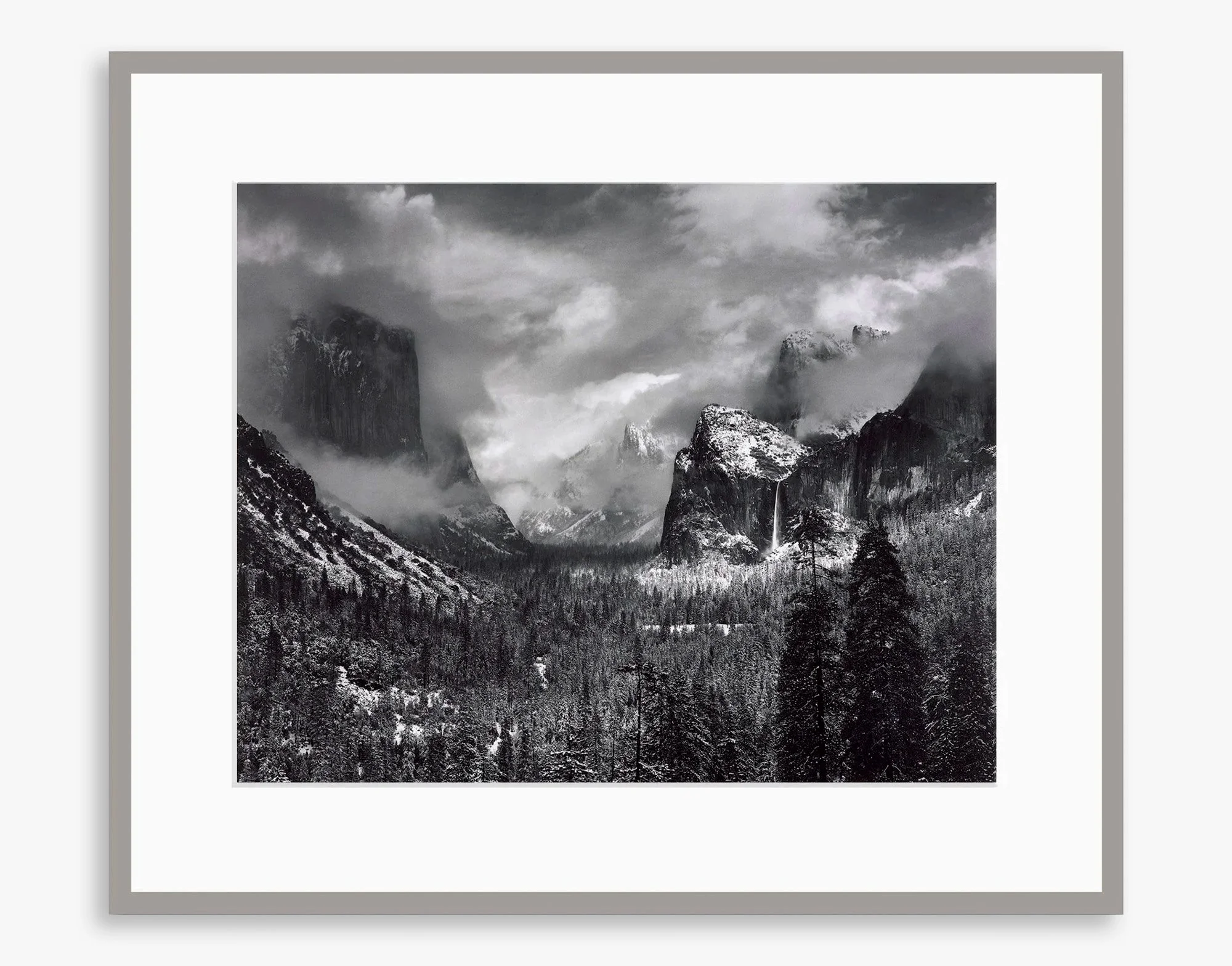
Clearing Winter Storm, Yosemite National Park, 1937
Photograph by Ansel Adams
Public Domain (Wikimedia Commons)
There are photographs we admire for a season, and there are photographs that quietly accompany us through a lifetime. The first satisfy our curiosity. The second continue to ask something of us. They become less an object to possess than a companion to consult, reminding us of the distance between where we are and where we hope to arrive.
For me, that photograph has been Clearing Winter Storm, Yosemite National Park, California 1937 by Ansel Adams.
It entered my life almost by accident.
I was in high school, carrying a camera with all the confidence and uncertainty of youth. Two other photographers and I had been assigned by the school newspaper to make an advertising photograph for a local women's clothing store. Before long, discussion hardened into argument. Voices rose. Everyone defended an idea that, in the end, probably mattered very little.
I remember thinking, I'm outta here.
I slipped outside and began the walk home.
It was February in southern Michigan and it was cold. Snow softened the familiar streets and muted the neighborhood. Winter has a way of simplifying the world. The landscape is reduced to form, light, and shadow.
I wandered until my attention settled on a modest brick house, its residential architecture incongruous among the commercial buildings around it — yet in other ways it looked like countless Midwestern homes, right down to the row of icicles hanging from its eaves.
They caught the pale winter light with surprising brilliance.
I stopped.
The camera came into my hands almost without thought. I wondered how to photograph them. Looking back, I realize I was asking a question that has stayed with me ever since. Why do certain things ask to be seen while countless others pass unnoticed? An icicle is only frozen water, yet in that moment it seemed to hold the conversation between weather, gravity, light, and time.
As I stood there, the front door opened.
An older gentleman smiled and invited me inside to warm up.
Only after stepping through the door did I discover it was a gallery.
The gallery was preparing for an exhibition of Ansel Adams photographs. Framed prints leaned against the walls while others had already been hung.
One print begged to be noticed and held me immediately.
Clearing Winter Storm.
I have forgotten much about that afternoon. Memory it seems, preserves only the moments that continue to shape us.
I remember standing before that photograph, unable to look away.
It revealed a world suspended between concealment and revelation. Clouds clung to the granite walls while soft light reached into Yosemite Valley. The storm had not fully departed, nor had the sun fully claimed the day. Everything existed in quiet balance.
Until then I had believed photographs were made with cameras.
Standing before Clearing Winter Storm, I began to suspect they were made with something else.
Years passed, but the photograph never loosened its hold on me. I encountered it again in books, in museum exhibitions and then as a poster on my own wall. Each time I saw it, it asked the same question, though I was only beginning to understand it.
After graduating from high school, I had the extraordinary good fortune to attend one of Ansel Adams' Yosemite workshops.
For the first time I stood at Tunnel View, looking across Yosemite Valley. Like everyone else, I hoped the landscape might yield itself to my camera.
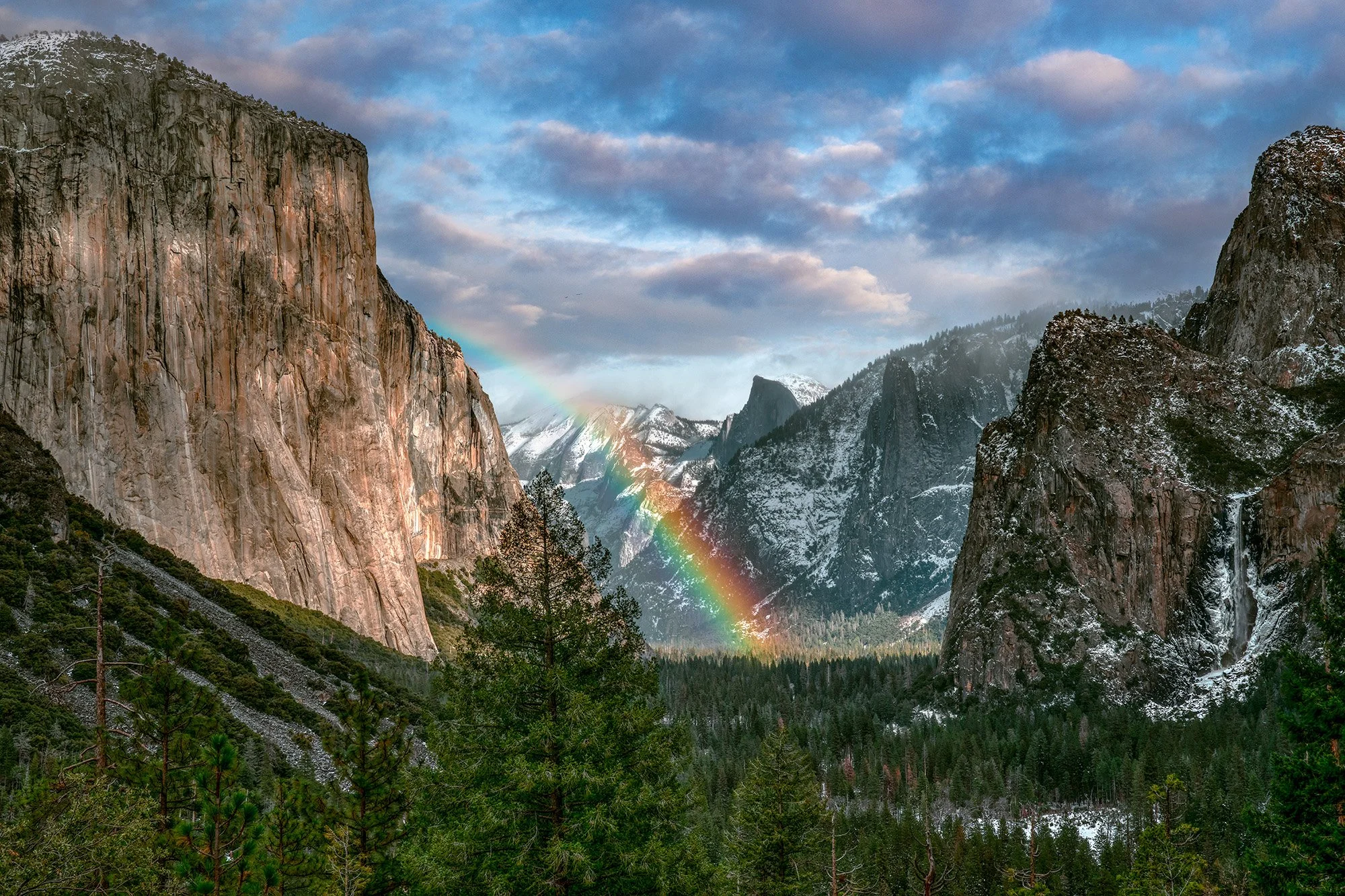
Rainbow at Tunnel View, Winter, Yosemite National Park, California
Photograph by ©Craig Varjabedian
What I remember most was not the discussion of exposure or printing, but something quieter. Good photographs cannot be forced into existence. One prepares, one waits, one pays attention. The landscape offers no guarantees.
Patience, I realized, was part of seeing itself.
On the final afternoon, Ansel laid out prints available for purchase.
There it was again.
Clearing Winter Storm.
I wanted it desperately.
The price was around eight hundred dollars, a staggering sum for a young photographer. I hurried to a pay phone and called my father, hoping he might lend me the money.
He listened.
Then he said no.
At the time I was crushed. No photograph, he believed, could justify such an expense.
Years have softened that memory. My father was a practical man. He measured value differently than I did. Still, I have often smiled at the thought that the photograph he considered impossibly expensive would one day be worth many times that amount.
Many years later, I finally acquired a print of Clearing Winter Storm.
Today it hangs in my studio.
People sometimes assume it hangs there because it is one of the greatest landscape photographs ever made.
Perhaps it is.
But that is not why it hangs there.
It reminds me of something I have not yet accomplished.
Not success.
Not mastery.
Something more.
After all these years I still believe there are photographs waiting for me that I have not yet learned to recognize. The print reminds me that the camera is only a part of photography. Long before the shutter is released comes the slower work of becoming attentive enough to notice when the ordinary world quietly discloses something extraordinary.
I think often of those icicles.
I never made the photograph.
At the time I thought I had missed an opportunity.
Now I wonder whether they had already fulfilled their purpose.
They brought me to a door I otherwise would have passed.
Beyond that door hung a photograph that has accompanied me ever since.
Each morning I pause before Clearing Winter Storm when I come to the studio. I no longer ask whether I will ever make a photograph equal to it.
Instead, I ask whether I will remain open to whatever the world still has to teach me.
Then I step outside.
Some days I return with photographs. Some days I don't.
But every day I return with the conviction that somewhere beyond the next bend in the trail, beyond the next change of weather, beyond the next ordinary afternoon, another moment of wonder is waiting for me to stop long enough to see it.
~from my Journal